Program Process Analysis: Stop Guessing. Start Understanding.

When programs struggle with delays, missed expectations, rework, or inconsistent results, the problem may not be the people doing the work. It may be the process they are working within.

In today’s complex business environment, successful program execution requires more than good intentions, talented people, and detailed project plans. It requires a clear understanding of how work actually gets done across teams, systems, and organizational boundaries.
Yet when performance falls short of expectations, organizations often rush to implement solutions before fully understanding the problem. They introduce new procedures, purchase technology, add approval steps, or ask employees to work harder—only to discover that the same challenges keep coming back.
There is a better approach.
Program Process Analysis provides the visibility organizations need to understand how work flows, identify the barriers to success, and make informed decisions about where to improve.
Instead of guessing what needs to change, teams can use evidence, stakeholder insights, and process analysis to develop improvements that address the underlying causes of performance issues.
Let's explore how to get started.
What Is Program Process Analysis?
Program Process Analysis is a structured approach to examining how a program operates, from its initial activities through its final deliverables and intended outcomes.
It looks beyond individual tasks to understand the relationships between activities, people, systems, decisions, and handoffs that collectively determine program performance.
Depending on the organization and the program, an analysis might examine:
Workflow and process flow: How does work move from one activity to the next?
Roles and responsibilities: Who performs each activity, makes decisions, and owns the outcomes?
Systems and technology: Do existing tools support the process, or do they create additional work?
Communication and coordination: How effectively do teams share information and manage dependencies?
Performance measures: Are the right metrics in place to evaluate efficiency, quality, timeliness, and results?
Policies and controls: Do current requirements support effective execution, or do they introduce unnecessary complexity?
The goal is not simply to document what happens. It is to understand why the process operates as it does, where performance breaks down, and what changes will produce meaningful results.
Why Program Process Analysis Matters
Programs frequently span multiple departments, functions, and systems. Even when each team performs its individual responsibilities well, the overall program can struggle because of gaps between those activities.
For example, a team may complete its work on time, but the next team may not receive the information it needs to begin. An approval may sit in someone's inbox for days. Data may be entered into multiple systems, creating inconsistencies and rework. Employees may follow different methods because standardized procedures are missing or unclear.
These problems rarely appear when looking at one task in isolation.
A broader process perspective helps organizations uncover the issues that affect overall performance.
Effective Program Process Analysis can help organizations:
Reduce unnecessary delays and cycle times.
Eliminate duplicate work and prevent avoidable errors.
Improve coordination across departments.
Clarify roles, decision rights, and accountability.
Identify opportunities for automation and better system integration.
Improve employee experience by removing frustrating process barriers.
Strengthen customer satisfaction and program outcomes.
Establish meaningful performance measures and sustainable controls.
Most importantly, it helps leaders distinguish between symptoms and root causes before investing time and resources in solutions.
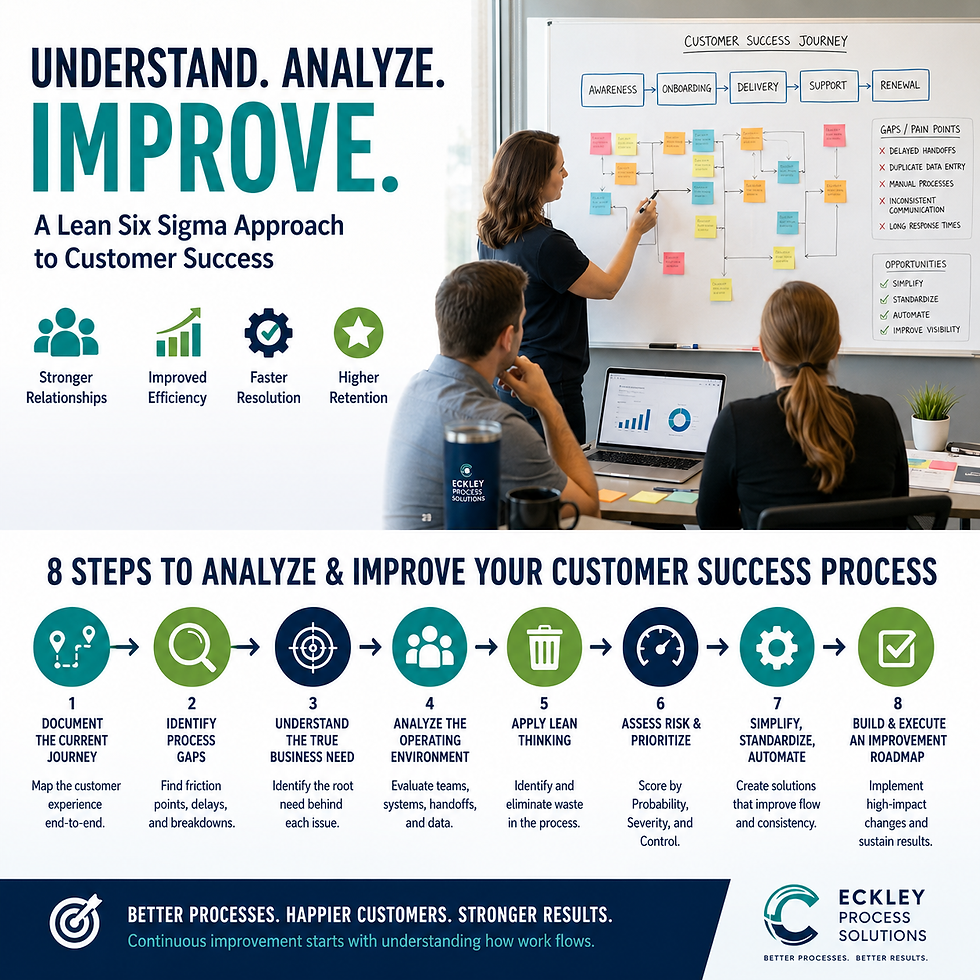
A Six-Step Framework for Program Process Analysis
A successful analysis does not need to begin with an elaborate methodology or an expensive technology initiative. Start with a structured approach that helps the team build a shared understanding of the current situation.
Step 1: Define the Scope
Before analyzing a process, establish what you are analyzing and why.
Without clear boundaries, teams can spend valuable time exploring issues that fall outside the program's objectives or attempting to solve every organizational problem at once.
Start by asking:
What program or business outcome are we evaluating?
What problem or performance gap prompted the analysis?
Where does the process begin and end?
Which departments, roles, systems, and stakeholders are involved?
What does success look like?
What constraints, dependencies, or requirements must be considered?
Define the desired outcomes as clearly as possible. These might include reducing approval cycle time, improving first-pass accuracy, increasing schedule adherence, or eliminating unnecessary administrative effort.
Practical tip: Develop a brief problem statement and a clearly defined scope before scheduling mapping sessions. This gives the team a common starting point and helps prevent scope creep.
Step 2: Map the Current State
Once the scope is established, document how the process actually works today.
This is where assumptions often begin to surface.
A procedure may describe the intended workflow, but employees may have developed workarounds to compensate for missing information, system limitations, unclear responsibilities, or impractical requirements.
Your current-state process map should reflect reality—not an idealized version of the process.
Capture the key activities, decisions, inputs, outputs, systems, handoffs, and responsible roles. Depending on the process, you may also need to document wait times, approval requirements, rework loops, and exceptions.
Useful tools include:
SIPOC: Defines suppliers, inputs, the high-level process, outputs, and customers.
Process flowcharts: Illustrate activities, decisions, and the sequence of work.
Swimlane diagrams: Show how responsibilities and handoffs are distributed across roles or departments.
Value stream maps: Help identify delays, waste, and opportunities to improve end-to-end flow.
Data collection sheets: Capture actual cycle times, error rates, waiting periods, and other performance measures.
Do not overlook the time between activities. In many business processes, the greatest delays occur while work is waiting for a decision, missing information, or the next available resource.
Practical tip: Validate the map with the people who perform the work. If the map does not reflect their daily experience, it is not ready to support improvement decisions.
Step 3: Gather Input From Stakeholders
Process maps tell part of the story. The people who interact with the process help explain what is happening and why.
Stakeholder engagement is especially important when a program crosses functional boundaries. Each group may see a different portion of the workflow, experience different challenges, or measure success differently.
Conduct interviews, facilitate workshops, observe work where appropriate, and ask open-ended questions.
For example:
What makes this process difficult to complete?
Where does work typically get delayed?
What information is frequently missing or incorrect?
Which activities require employees to follow up repeatedly?
Where do responsibilities become unclear?
What workarounds have become part of the normal routine?
What would make the process easier and more reliable?
Listen for differences between the documented process and actual practice. These gaps often reveal opportunities that may not be visible in existing procedures or performance reports.
It is also important to create an environment where people feel comfortable sharing their experiences without fear of blame.
Remember: Employees are often working around process problems, not creating them. Their insights are essential to developing solutions that work in practice.
Step 4: Identify Pain Points and Waste
With the current-state process documented and stakeholder input collected, the next step is to identify where the process loses time, creates unnecessary effort, or fails to deliver consistent results.
Lean principles provide a useful lens for this analysis.
Look for common sources of waste, including:
Waiting: Work sits idle while awaiting approvals, information, or resources.
Rework: Errors, incomplete submissions, or unclear requirements force activities to be repeated.
Bottlenecks: One activity, person, or approval point limits the flow of the entire process.
Overprocessing: Teams perform unnecessary checks, create redundant reports, or enter the same information multiple times.
Excess motion or effort: Employees spend time searching for information, navigating disconnected systems, or chasing updates.
Defects: Incorrect or incomplete outputs create downstream problems.
Communication gaps: Important information is delayed, lost, or misunderstood.
Role confusion: Multiple people assume someone else owns an activity, or several people perform the same task unnecessarily.
Where possible, quantify the impact. Estimate the time lost to waiting, count recurring errors, measure rework frequency, or calculate the number of handoffs involved.
Quantification helps the team distinguish between issues that are merely frustrating and those that materially affect program performance.
Step 5: Identify Themes and Root Causes
A list of pain points is useful, but it does not tell you which problems deserve attention or what is causing them.
This is where root cause analysis becomes critical.
Several seemingly unrelated problems may have a common underlying cause.
For example, missed deadlines, repeated status requests, and incomplete handoffs might all stem from unclear ownership and the absence of a standardized information-sharing process.
Rather than addressing each symptom separately, investigate the underlying conditions that allow these issues to occur.
Useful tools include:
5 Whys: Repeatedly asks why a problem occurs to move beyond surface-level explanations.
Fishbone diagrams: Organize potential causes into categories such as people, methods, systems, information, and measurement.
Pareto analysis: Helps identify the categories of problems contributing most significantly to the overall impact.
Data analysis: Tests whether suspected causes are supported by actual performance evidence.
Be careful not to accept the first explanation as the root cause. Statements such as "people aren't following the process" or "we need a new system" may describe symptoms or proposed solutions rather than explain why the problem exists.
The objective is to understand the conditions that produce the unwanted outcome.
Step 6: Prioritize Improvement Opportunities
Not every finding requires a major project, and not every improvement needs to wait for a technology implementation.
Once the team understands the problems and their causes, evaluate potential improvements based on their expected impact, effort, risk, cost, and feasibility.
Consider three categories:
Quick wins: Relatively simple changes that can eliminate unnecessary steps, clarify instructions, improve communication, or reduce recurring administrative work.
Targeted improvements: Changes that require cross-functional coordination, revised responsibilities, updated procedures, or better performance controls.
Strategic initiatives: Larger opportunities involving system integration, workflow automation, organizational redesign, or significant policy and process changes.
Prioritize improvements that address root causes and support the program's objectives.
For example, clarifying an approval threshold and assigning a clear decision owner may reduce delays more effectively than adding another tracking spreadsheet. Standardizing required information at the beginning of a process may prevent more rework than introducing additional downstream inspections.
Develop an improvement roadmap that identifies the recommended actions, responsible owners, expected benefits, dependencies, and measures of success.
The goal is to move from analysis to practical, sustainable action.
From Analysis to Sustainable Improvement
Program Process Analysis should not end when the process map is complete or the findings are presented to leadership.
The real value comes from using those findings to improve performance and sustain the results.
After prioritizing opportunities, establish a plan for implementation and measurement.
Depending on the scope of the initiative, this may include:
Designing and validating a future-state process.
Updating policies, standard operating procedures, and work instructions.
Clarifying roles and decision-making authority.
Improving workflows and system requirements.
Developing training and change management plans.
Establishing performance indicators and reporting routines.
Implementing control plans and ownership for ongoing monitoring.
Select measures that directly connect to the problem being addressed. For example, an initiative targeting approval delays might track average approval time, total process cycle time, and the percentage of approvals completed within the agreed service level.
Establish a baseline before implementing changes, then compare actual results against that baseline.
Finally, assign ownership for maintaining the improved process. Without clear accountability and appropriate controls, even well-designed improvements can gradually lose their effectiveness.
Common Mistakes to Avoid
Even well-intentioned analysis efforts can miss the mark when teams move too quickly or focus on the wrong things.
Watch for these common mistakes:
1. Starting with a solution instead of a problem. Assuming automation, additional staffing, or new software will resolve the issue can lead to expensive changes that leave the underlying problem untouched.
2. Mapping the documented process instead of the actual process. An idealized map hides workarounds, informal approvals, and other realities that affect performance.
3. Excluding the people who do the work. A process designed without input from its users may look good on paper but prove difficult to execute.
4. Treating every pain point as equally important. Without prioritization, teams can become overwhelmed by a long list of findings and struggle to make meaningful progress.
5. Confusing correlation with root cause. A problem that occurs alongside another condition is not necessarily caused by it. Validate assumptions with evidence.
6. Failing to measure results. If improvements are not measured against a baseline, the organization cannot confidently determine whether the changes delivered the expected benefits.
Avoiding these mistakes helps ensure that process analysis becomes a foundation for better decisions rather than another documentation exercise.
The Bigger Picture: Better Processes Create Better Outcomes
When organizations improve a program's underlying processes, the benefits extend beyond efficiency.
Employees spend less time chasing information and correcting mistakes. Leaders gain better visibility into performance and risks. Departments coordinate more effectively. Customers and stakeholders receive more consistent results.
Perhaps most importantly, teams develop a shared understanding of how work flows across the organization and where they can make the greatest difference.
This is the power of combining process mapping, stakeholder engagement, data analysis, root cause investigation, and continuous improvement into one structured approach.
At Eckley Process Solutions, we believe meaningful improvement starts with understanding the current state before attempting to change it.
You cannot improve what you do not understand—and you cannot build sustainable solutions by guessing.
Before launching another initiative, introducing another tool, or asking your team to work harder, take a step back.
Map the process. Listen to the people doing the work. Examine the evidence. Identify the root causes. Then focus your improvement efforts where they will deliver the greatest value.
The best improvements do not begin with assumptions. They begin with a clear understanding of how work really gets done.
Stop guessing. Start understanding. Then start improving.
Ready to uncover opportunities in your organization's programs and business processes? Eckley Process Solutions helps organizations understand how work gets done, identify process inefficiencies, and develop practical improvement strategies that support better performance and sustainable results.


Comments