Customer Success Analysis: Using Lean Six Sigma to Improve the Customer Experience

Every organization wants happier customers, stronger retention, and long-term loyalty. Yet many improvement efforts focus on the symptoms—missed deadlines, customer complaints, or declining satisfaction scores—rather than understanding why those issues occur.
One of the most rewarding projects I've had the opportunity to lead was a comprehensive Customer Success Analysis. The goal wasn't simply to fix isolated problems. It was to understand how work flowed from the customer's perspective, identify where friction existed, and uncover opportunities to improve the entire experience.
By applying Lean Six Sigma principles, we were able to move beyond assumptions and use a structured methodology to document the current state, identify waste, and prioritize improvements that delivered measurable value for both the customer and the business.
Why Start with the Process?
Customer success isn't owned by one department.
It spans sales, marketing, finance, operations, customer support, product teams, and numerous technology platforms. Every handoff, approval, data entry, and communication either creates value—or creates friction.
Before recommending technology or redesigning workflows, we first needed to answer one simple question:
How does work actually flow today?
That meant observing reality rather than relying on procedures or assumptions.
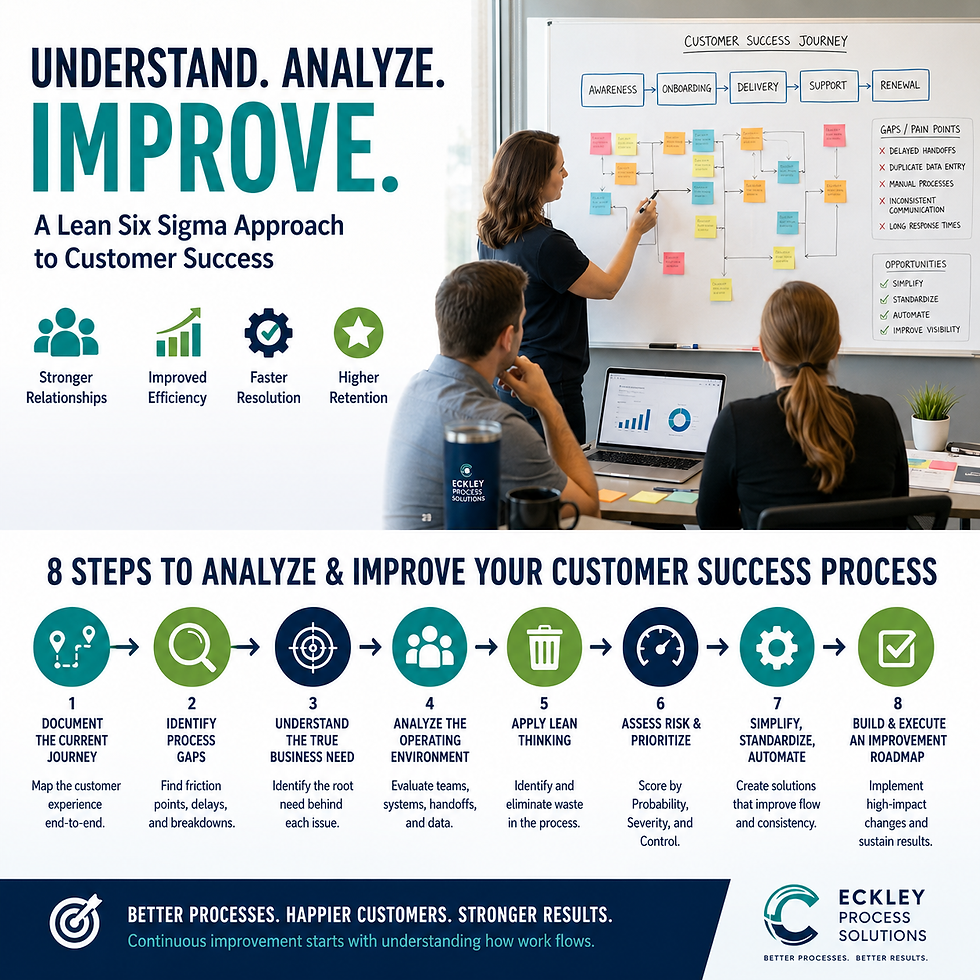
Step 1: Document the Current Customer Journey
Our first objective was creating a complete picture of the customer experience.
Rather than focusing on departments, we followed the customer from the initial inquiry through onboarding, service delivery, ongoing support, and long-term relationship management.
During process mapping we documented:
Every major process step
Decision points
Customer touchpoints
Internal handoffs
Systems used
Required documentation
Manual activities
Waiting periods
Rework loops
Exception paths
This created a shared understanding of how work actually flowed across the organization.
Step 2: Identify Process Gaps
Once the current state was visible, every gap became much easier to recognize.
Rather than asking, "What's wrong?", we asked:
Where are customers experiencing delays?
Where does work stop moving?
Where are employees creating workarounds?
Where are decisions inconsistent?
Where is information duplicated?
Where do customers have to repeat themselves?
Each identified gap was documented with a unique reference number, making it easy to trace back to the exact location within the process map.
Step 3: Understand the True Business Need
One of the biggest mistakes organizations make is solving the symptom instead of the problem.
For every gap identified, we asked:
What business need is this gap revealing?
Sometimes the answer wasn't a software issue at all.
Instead, the true need involved:
Better process definition
Clear ownership
Improved communication
Standardized work
Better documentation
Better reporting
More reliable data
Clear governance
Understanding the underlying need prevented expensive solutions that failed to solve the real problem.
Step 4: Analyze the Entire Operating Environment
Customer success depends on far more than one workflow.
We documented every supporting element involved in delivering the experience, including:
Cross-functional teams
Department handoffs
Roles and responsibilities (RACI)
Applications and systems
Policies
Forms
Reporting
Communication methods
Data sources
Regulatory or financial requirements
This systems-thinking approach helped reveal how seemingly unrelated issues were actually connected.
Step 5: Apply Lean Thinking
After documenting the current state, we evaluated each gap through a Lean lens.
We asked:
Is this activity creating value?
Is it required?
Could it be simplified?
Is it duplicated?
Is it preventing flow?
Many issues aligned directly with the Eight Wastes of Lean, including:
Waiting
Motion
Transportation
Defects
Overprocessing
Overproduction
Inventory
Underutilized talent
Instead of fixing isolated tasks, we focused on eliminating waste throughout the customer journey.
Step 6: Assess Risk and Prioritize Improvements
Not every problem deserves immediate attention.
To prioritize improvement opportunities objectively, we evaluated each gap using three simple criteria:
Probability — How often does this occur?
Severity — What is the impact on the customer and business?
Control (Detection) — How likely are we to detect or prevent the issue before it affects the customer?
These factors were combined into a simple risk score that allowed the team to focus first on the highest-impact opportunities rather than the loudest complaints.
This created a clear, data-driven roadmap for improvement.
Step 7: Identify Opportunities to Simplify, Standardize, and Automate
Only after understanding the process did we begin discussing improvements.
Common opportunities included:
Standardizing work instructions
Clarifying ownership
Improving documentation
Eliminating duplicate data entry
Streamlining approvals
Improving reporting visibility
Simplifying decision making
Automating repetitive manual tasks
Improving system integration
Reducing unnecessary handoffs
Technology became an enabler—not the starting point.
Step 8: Build an Improvement Roadmap
With every gap analyzed, improvement ideas were grouped into actionable initiatives.
Quick wins were implemented first while larger process redesigns became part of longer-term improvement projects.
This balanced immediate value with sustainable transformation.
Why DMAIC Works So Well
This project naturally aligned with the DMAIC methodology.
DMAIC Phase | Customer Success Activity |
Define | Understand customer needs and project objectives |
Measure | Document the current process and collect data |
Analyze | Identify gaps, waste, and root causes |
Improve | Simplify, standardize, and redesign processes |
Control | Monitor results, document standards, and sustain improvements |
DMAIC provides structure, while Lean provides the mindset of eliminating waste and maximizing customer value.
Together, they create a powerful framework for continuous improvement.
The Biggest Lesson
One of the most valuable lessons from this project was that customer success is rarely limited by people—it is often limited by processes.
Employees typically work incredibly hard to serve customers, but unclear workflows, disconnected systems, inconsistent processes, and unnecessary complexity make success more difficult than it needs to be.
When organizations take the time to understand how work truly flows, they uncover opportunities that improve both the customer experience and the employee experience.
Final Thoughts
The best customer experiences don't happen by accident. They are intentionally designed, continuously evaluated, and relentlessly improved.
A structured Customer Success Analysis gives organizations the visibility needed to reduce friction, improve collaboration, eliminate waste, and create processes that consistently deliver value.
Whether you're improving onboarding, service delivery, account management, or the entire customer lifecycle, remember this:
Don't start with the technology. Start with the process. Understand how value flows, identify what's getting in the way, and let Lean Six Sigma guide the path to lasting improvement.
💡 Tammy's Tiny Tip
A process map is one of the most powerful tools in continuous improvement—but only if you use it to ask better questions. Document the current state, challenge every handoff, identify the waste, and prioritize improvements based on risk and customer impact. You'll often discover that the biggest opportunities were hiding in plain sight.


Comments