From Friction to Flow: How a Kaizen Event Turned a Complex Process into an Actionable Roadmap

One of the most rewarding things about facilitating a Kaizen event is watching what happens when people from across an organization come together to focus on a shared process.
People who may normally interact only through emails, handoffs, meetings, or escalations suddenly find themselves in the same room.
They see the process together.
They hear each other's challenges.
And perhaps most importantly, they begin to understand that many of the frustrations they experience are not caused by people—they are caused by the process itself.
That is exactly what happened during a recent three-day Kaizen event focused on improving a subcontractor agreement approval and activation process.
The event brought together cross-functional stakeholders to examine a complex process that had developed challenges around ownership, submission quality, decision authority, visibility, delays, and rework. Over three days, the team moved from understanding the current state to designing a future state and ultimately committing to a prioritized implementation roadmap.
The result was more than a collection of ideas.
It was a shared plan for moving from fragmented work to a more predictable, manageable, and scalable process.

The Challenge: When a Process Has Too Many Gaps
Before improvement can begin, a team must develop a common understanding of the problem.
The process being examined involved multiple stakeholders, handoffs, approvals, systems, and decision points. As the team explored the current state, several recurring challenges emerged:
Inconsistent ownership
Incomplete submissions entering the process
Unclear decision authority
Rework caused by missing or inaccurate information
Limited end-to-end visibility
Delays occurring at multiple points in the workflow
Administrative effort that did not add value
These are common symptoms of a process that has evolved over time without a fully integrated operating model.
One of the most important lessons from the event was that the largest opportunity was not necessarily inside the approval process itself.
It was controlling the work before it entered the flow.
The team documented 27 pain points, with approximately 63% categorized as process-related. In addition, approximately 88% of Customer Deal Desk rejections were linked to scope-related issues.
That evidence helped the team focus on a critical Lean principle:
Fix problems at the source rather than allowing defects to travel downstream.
The Kaizen Approach: Understand, Design, Commit
A successful Kaizen event needs structure.
For this event, the three days followed a deliberate progression:
1. Understand
The first step was to build a shared fact base.
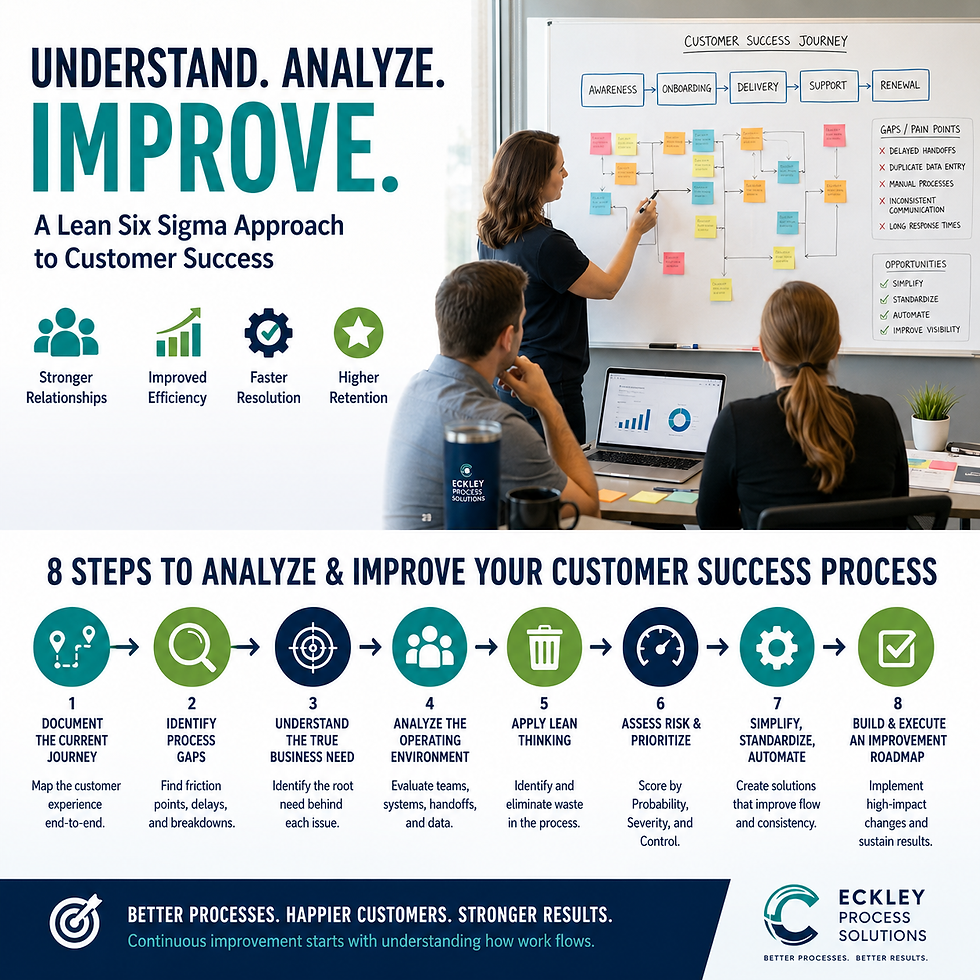
The team mapped the current process, including:
Process steps
Handoffs
Decision points
Roles
Delays
Pain points
Rework loops
Areas of unclear ownership
This is where the real power of cross-functional process mapping becomes visible.
Everyone enters the room with their own perspective of how the process works.
But when the process is mapped visually from end to end, assumptions are challenged.
Teams begin to see where work waits.
They identify where information is incomplete.
They recognize where responsibilities overlap—or where no one clearly owns the next step.
The current-state map becomes more than a diagram.
It becomes a shared understanding of reality.
2. Design
Once the current state was understood, the team shifted from identifying problems to analyzing root causes and designing solutions.
The goal was not simply to eliminate individual pain points.
The goal was to create a future-state process that would be easier to manage, more predictable, and more scalable.
The future-state design centered around four key elements:
Complete Intake
Required information should be available before work enters the process.
This includes critical inputs such as scope or PWS information, staffing requirements, dates, financial information, and other required data.
A process cannot flow efficiently if incomplete work is continuously introduced into the system.
Quality Gates
Clear quality gates help determine whether work is ready to move forward.
Instead of discovering missing information after multiple downstream handoffs, incomplete packages can be identified and returned early.
Each step should also have one clearly accountable owner.
Managed Workflow
The team identified the importance of greater visibility across the process.
A managed workflow should allow stakeholders to understand:
Current status
Time spent in each stage
Pending approvals
Exceptions
Ownership
Process history
Visibility is essential for managing flow.
If work cannot be seen, it cannot be effectively managed.
Scale and Sustain
Improvement does not end when the future-state process is designed.
The organization also needs governance, supporting tools, training, performance measures, and a structured approach for scaling what works.
The Kaizen identified opportunities involving governance, workflow evaluations, technology options, AI pilots, training, and KPI development as part of the longer-term improvement strategy.
3. Commit
This is where many improvement efforts fall short.
Teams identify problems.
They develop excellent ideas.
They create a future-state process.
Then everyone returns to their day jobs.
A Kaizen event should not end with a list of recommendations.
It should end with commitments.
During the final phase of the event, the team prioritized solutions, identified owners, and developed an implementation roadmap.
The result was a single cross-functional roadmap containing immediate actions and a managed backlog for follow-on improvement opportunities.
Turning Ideas into Action: The 30-60-90 Day Roadmap
One of the most important deliverables from the event was the implementation roadmap.
The first 90 days were designed to establish the controls, pilots, governance, and requirements necessary to support longer-term transformation.
The First 30 Days: Establish the Foundation
The initial focus included activities such as:
Validating process paths
Beginning integration discussions
Clarifying policies
Assessing approval requirements
Aligning cross-functional practices
Drafting governance
The goal of the first phase was not to solve everything.
It was to create clarity around the most important foundational issues.
Days 31–60: Begin Testing and Implementing Controls
The next phase focused on moving concepts into action.
Priorities included:
Launching an improved intake approach
Piloting AI support for scope development
Rolling out quality gates
Defining approval decision frameworks
This is an important stage in process improvement.
The organization begins testing the future-state concepts rather than trying to implement a massive transformation all at once.
Days 61–90: Prepare for Scale
The third phase focused on evaluating workflow options, confirming governance and RACI responsibilities, and developing implementation requirements.
The longer-term opportunity identified by the team was a fully integrated end-to-end workflow solution.
However, the team recognized an important principle:
Technology should scale a good process—not automate a broken one.
The first 90 days were designed to establish the controls, governance, requirements, and insights needed before defining a larger strategic implementation roadmap.
Why Governance Matters After the Kaizen
A Kaizen event can create tremendous momentum.
But momentum without a management system eventually fades.
That is why governance was a critical part of the future-state design.
The recommended management system included:
Governance Team
A cross-functional group responsible for:
Confirming decision rights
Removing blockers
Approving cross-functional decisions
Action Reviews
A disciplined review process to maintain visibility into:
Owners
Due dates
Status
Dependencies
Risks
Decisions
Monthly Performance Reviews
Regular reviews focused on:
Process performance
Queue health
Exceptions
Lessons learned
Priority adjustments
The team also identified a core set of KPIs to monitor the health of the process, including:
End-to-end lead time
Time in stage
Intake completeness
Intake accuracy
Scope or PWS exception rate
Queue aging
Owner visibility
These measures help shift the organization from managing individual problems to managing the performance of the overall process.
The Real Magic of Kaizen Is the People
As a facilitator, I can bring the methodology.
I can structure the conversations.
I can ask the questions.
I can help the team visualize the process and identify opportunities.
But the real expertise comes from the people doing and supporting the work every day.
That is why cross-functional Kaizen events can be so powerful.
When the environment is respectful and focused on the process rather than personalities, something remarkable happens.
People begin to move away from statements like:
"My team does their part."
And start asking:
"What does the process need to work better?"
That shift changes everything.
Silos begin to break down.
Assumptions are challenged.
People gain a better appreciation for upstream and downstream partners.
And improvement opportunities become easier to identify because the entire system is finally visible.
A Kaizen Event Is Not the Finish Line
One of the most important messages from this event was that the Kaizen itself was only the beginning.
The workshop produced the materials and decisions needed to begin execution:
Confirmed priorities
Defined improvement opportunities
Named owners
A 30-60-90 day roadmap
Governance recommendations
KPI framework
A backlog of future improvement opportunities
The next step is disciplined follow-through.
That means confirming ownership, launching the action plan, establishing the governance cadence, measuring performance, and managing additional opportunities through a structured improvement backlog.
Final Thoughts
Kaizen is often translated as continuous improvement, but effective improvement requires more than identifying opportunities.
It requires alignment.
It requires collaboration.
It requires disciplined execution.
And it requires a willingness to look honestly at how work actually flows across an organization.
This three-day event demonstrated what can happen when cross-functional teams step away from their individual perspectives and focus on a shared process.
The team moved from a fragmented collection of pain points to a common understanding of the current state.
From there, they designed a more structured future state.
And most importantly, they left with a roadmap for action.
That is what makes a Kaizen event valuable.
Not the sticky notes.
Not the workshop.
Not even the process map.
The real value comes from what happens next.
Improvement becomes real when alignment turns into action—and action becomes a sustained way of working.


Comments